Any Amateur Astronomers/Stargazers in here?

avatar33

e-Hustler
Dec 5, 2009
3,838
52
48
Calgary, AB
I've been dying to get into astronomy my whole life, I bought a used $200 Mead telescope on eBay a couple years ago and had lots of fun with it, but I realize that I still have a lot to learn in terms of how to use telescopes/lenses and how to locate stars/galaxies, etc...

Like for instance I would like to be able to locate my birth star (it's gay I know, but it's a star that started emitting light the same day I was born) but I have no idea how to locate it in the sky even with the right coordinates...

What material do you guys use? Did you take any online classes or anything?

VBLu6cn.jpg


Yeah, years ago I owned an 8" Celestron newtonian on EQ 5. Loved it.

Most of the stuff I know about how to find objects on the sky was from an astronomy class I attended in high school. I suggest you go on a local astronomy meet and go out with them a couple nights. You'll learn a ton.

Here are two peasant pics I took 10 years ago simply by pointing my 3MP camera in to the telescope's eyepiece:

2QU7k3f.jpg


Saturn (it was waaayy more detailed live):

w9MdwkH.jpg
 
I was awake at 4am and went out to see a clear sky. Spotted Jupiter & Mars by the moon and I think Mercury on the east horizon but not sure. Definitely Jupiter & Mars though - I can recognise them straight away.
 
I've dabbled a bit but didn't dig too deep.

I know that a seasoned amateur astronomer reads the skymap as a skymap (no, really), so rather than referring to the coordinates to find an object of interest, they use an easy to find object, and navigate to the object of interest by locating the next closest object to the other, until you arrive at the object you wanted to find.

For example, the moon is easy enough to spot. You know venus is close to the moon at the moment, you get to the next closest star to venus by moving 60 degrees, and so on.

Another fun thing to do is watch for satellites at night. They are everywhere and it doesn't take long to spot one. You'll notice a what appears to be a star fading in or just moving faster than an airplane can, and as you follow it, it gets brighter or darker depending on the landscape and cloud cover eclipsing it. Sometimes it gets very bright, sometimes to goes so dim you can no longer see it, only to get bright again, until it finally gets eclipsed by earth itself.
 
I've dabbled a bit but didn't dig too deep.

I know that a seasoned amateur astronomer reads the skymap as a skymap (no, really), so rather than referring to the coordinates to find an object of interest, they use an easy to find object, and navigate to the object of interest by locating the next closest object to the other, until you arrive at the object you wanted to find.

For example, the moon is easy enough to spot. You know venus is close to the moon at the moment, you get to the next closest star to venus by moving 60 degrees, and so on.

Another fun thing to do is watch for satellites at night. They are everywhere and it doesn't take long to spot one. You'll notice a what appears to be a star fading in or just moving faster than an airplane can, and as you follow it, it gets brighter or darker depending on the landscape and cloud cover eclipsing it. Sometimes it gets very bright, sometimes to goes so dim you can no longer see it, only to get bright again, until it finally gets eclipsed by earth itself.

Well yeah that's for major stars and planets, but if you wanted to locate a very specific star in a remote galaxy, say 12 Ophiuchi or Leporis 13, then you'd definitely need to use coordinates and know what you're doing! ;)
 
Google Sky Map for Android is neat to play around with and help locate the general vicinity of stars and constellations.
 
I thought about making a thread about this as I recently got into it a bit. Been meaning to start a damn site about it too. It's a high $$$ niche and people spend a fortune on all sorts of upgrades and toys. I had my first scope like 10 years or so ago and had fun with that but also didn't know what I was really doing and sold it eventually. Just got back into it all recently as well as photography.

I will say if you want to get started get a go-to (you basically align it and it finds things for you) telescope so you don't have to dick around with searching for things. That can be fun on its own and you can learn about the sky and all that but nothing like pushing a button and seeing what you want. Trying to find things on your own can become very frustrating. Even aligning the scope can be a pain in the ass at times.

As far as scopes go the Celestron Nexstar SE series is a good place to start (for viewing, at least). I have the Nexstar 4SE. It's pretty small but it's a good starter scope. Generally speaking bigger aperture is almost always better but also don't forget portability. If you've got a 60 lbs behemoth scope you don't feel like ever dragging out then what's the point? Even binoculars can be fun in a dark sky site. Dark sky is key, light pollution can really kill any night sky experience.

Figure out what you want to accomplish with this hobby exactly before you go and start purchasing equipment. Do you want to look at deep sky objects like star clusters, galaxies, etc or do you want good views of the planets and moon? Do you want to do astrophotography? The different types of telescopes are best suited for certain tasks. I want to get into astrophotography and I quickly realized there's a pretty steep learning curve and it can get expensive pretty quickly (there's always a bigger scope or better camera you can get, mounts, accessories, etc). I already want a second scope for wide field views and faster imaging. Ugh.

I learned all this stuff by just doing a lot of reading. I might take a night time photography workshop that is coming up. Should be cool as I haven't really been out in really dark skies with the scope yet.

Here's some videos and images I've made. Keep in mind, with astrophotography, aside from the moon, taking an image is not the majority of the work. It's all about the processing and getting as much out of the image / video data as you can. So that's something to consider if that's something you want to get into and think it's just "point and shoot". There's a lot of things to learn. If you like the challenge and don't set your expectations too high then it's a lot of fun though! I haven't attempted any deep sky imaging yet. All these were taken with my Nexstar 4SE and Canon Rebel T3i, well except for the last 2, that's obviously done without the scope.

Here's the video of Saturn I made:

[ame=http://www.youtube.com/watch?v=An2pC20uIMc]Saturn Through Nexstar 4SE Telescope - YouTube[/ame]


And here's the image I pulled out of that:

935251_10152827522000371_2091422578_n.jpg


Some video of the moon I made and some gay webmaster music to go with it.

[ame=http://www.youtube.com/watch?v=c7pRJ0IaueI]Moon with Celestron Nexstar 4SE and Canon Rebel T3i - May 17, 2013 - YouTube[/ame]


(In the below video you can see my scope doesn't have that wide of a field of view - something to consider when choosing a scope)

[ame=http://www.youtube.com/watch?v=2rJ2XmRK8ZQ]Supermoon Through Nexstar 4SE Telescope - YouTube[/ame]


Here's a hi-res of the first shot

17512_10152926976430371_314550395_n.jpg


Close-ups:

984069_10152823466350371_594767425_n.jpg


947053_10152808413155371_710915784_n.jpg


969325_10152808413060371_148559849_n.jpg


Not particularly space related but the sky nonetheless. Taken over Lake Ontario during last week's storm.

1044510_10153019354760371_1583963273_n.jpg


And let me finish off with another photo I took a few days ago which every gay webmaster can appreciate:

998735_10153047838390371_1900287562_n.jpg
 
I do not own a telescope BUT i use stellarium > Stellarium There are extra packs within the program you can download so if you know the name of your birthstar you can prolly find it in the sky.

As for classes I took Intro to Astronomy on courseras website... idk if its still open though check and see!
 
I got a Celestron AstroMaster as a present, and its pretty cool. Although, my expectations were a bit high ( i was expecting to see Alien Dick on far off planets, etc etc) So now i just end up spying on my city from the 40th floor - definitely see more dick this way!
 
Do you want to do astrophotography?

Yes and yes! That's exactly what I would want to do once I'm comfortable with the basics. I want to be the guy that takes nice pics of remote galaxies, shooting stars and UFOs lol (kidding... or am I?)

Your pics are nice, but I'd like to be able to get pictures even sharper and more vivid than that. I wouldn't mind spending the money for it either. I've played with my basic telescope for too long and the reason I gave up on it is precisely because I wasn't impressed with the quality of what I was seeing. The only thing that was nice and sharp was the moon.

Other question for ya: I see you live in T.O. which is probably the worst city in Canada for stargazing... do you still manage to get some quality shots out of the city or do you need to drive a couple miles outside the city?
 
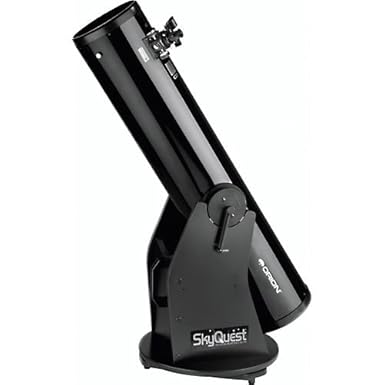
What do you guys think of this Dobsonian to use in the backyard? [ame=http://www.amazon.com/camera-photo/dp/B001DDW9V6]Amazon.com: Orion 8945 SkyQuest XT8 Classic Dobsonian Telescope: Camera & Photo[/ame]


41v0U-CiqWL._SX385_.jpg


31JWsPWkTYL._SX385_.jpg
 
I just bought a vacation home in the sticks. Someone recommend me a decent telescope to check out the stars. Nothing stupid expensive ... maybe middle of the road.
 
[ame=http://www.youtube.com/watch?v=p9n9gW1wCks]Mother Love Bone - Stargazer - YouTube[/ame]
 
as i was scrolling down i knew goatse was going to be there.
i love the stars, but dont know enough really. I like to use google sly map to check them out